
Jasper: Is Maligne Canyon or Maligne Lake Open in 2026?
Maligne Canyon and Cavell Road stay closed for 2026, and the Maligne cruise has ended for the season. Canyon and road status checked 19 October 2026.
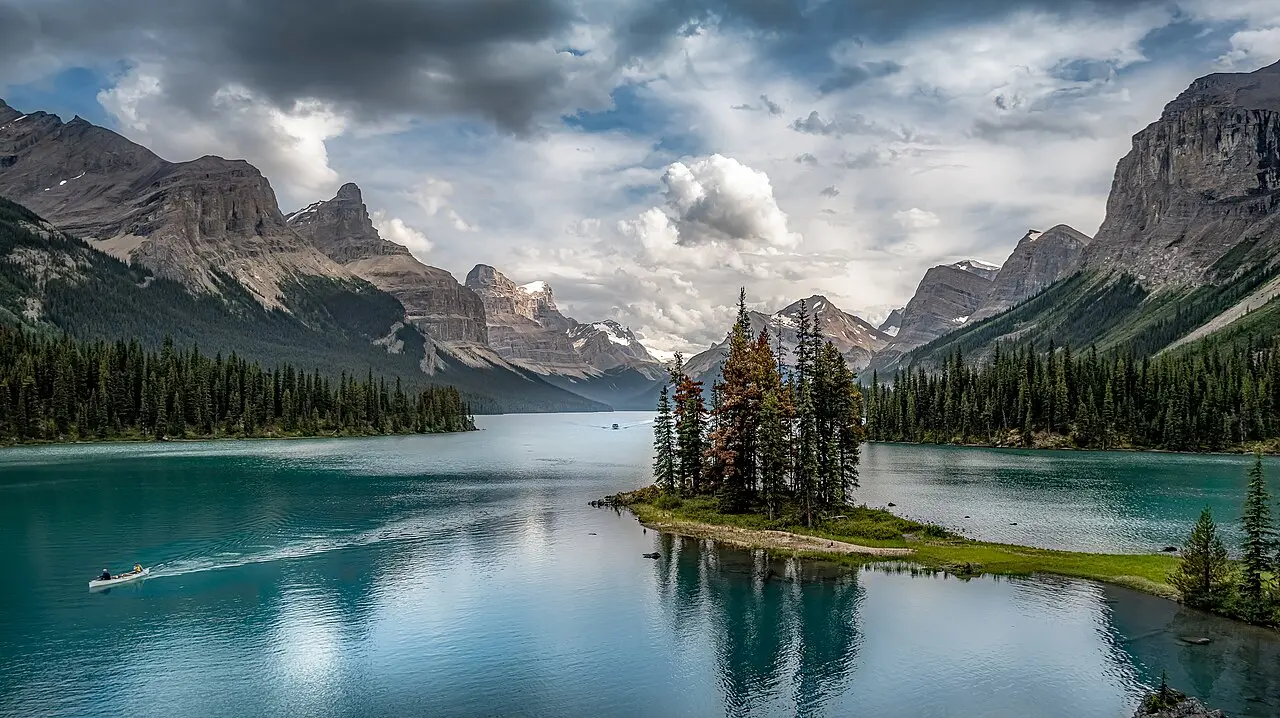
Maligne Lake is open - the road and the lakeshore trails - but the Spirit Island cruise finished its 2026 season on 11 October (Pursuit lists 28 May to 10 October for 2027). Maligne Canyon isn’t: it stays closed for the whole of the 2026 season, and so does Cavell Road. The rest of Jasper is open and busy again, with 2,392,849 visits in the 2025-26 fiscal year, within a whisker of the 2,407,529 it recorded the year before the 2024 wildfire. The Icefields Parkway, Athabasca Falls and almost every trail are running normally, Miette Hot Springs has closed for the season (back in spring 2027), and the camping season is winding down on its usual dates.
The fire that caused all this arrived on 24 July 2024, two days after the town and park were evacuated. It burned more than 32,000 hectares, the largest fire here in a century, and destroyed 358 of the townsite’s 1,113 structures - roughly a third of the buildings, though the hospital, library and fire hall were saved. Recovery has been quick in some places and slow in others, and the difference matters when you plan.
Is Maligne Canyon open? Not for the 2026 season
No. Parks Canada’s status page still lists Maligne Canyon and the Maligne Canyon Picnic day-use area as “Closed / Not permitted” - re-checked 19 October 2026 (page modified 13 October), unchanged since this article’s first check in July. The closure covers the gorge trail from the First Bridge parking lot to the Fifth Bridge junction, and Parks Canada’s order, issued 13 August 2026, says winter access to the canyon for winter recreational activity is prohibited, so there’s no Maligne Canyon icewalk in winter 2026-27. Pursuit, which runs the guided icewalks, lists Maligne Canyon Icewalks as closed for the season (as of 19 October 2026).
The fire stripped trees and vegetation off the canyon’s high-angle slopes, and Parks Canada’s recovery page says this “creates an increased risk for debris flows and landslides” on ground people would otherwise walk directly under. Hazard-tree removal is finished; geotechnical and infrastructure assessments are still running, and as of the same 31 August update the reopening project remains “in the early planning stages, with technical studies and design concepts under development.” So when will it reopen? No date exists yet, for 2027 or any other year.
One wrinkle, only relevant if you’re hiking the multi-day Skyline Trail rather than visiting the canyon itself: the status page separately lists a “Skyline - Maligne Canyon” backcountry trailhead as open for hiking. That’s the far end of the Skyline Trail from Maligne Lake, not the closed canyon trail - it doesn’t change anything for a day visitor, but it’s why the page can look contradictory if you don’t know the two are different places. And if you see an ice-canyon walk advertised for Jasper in winter 2026-27, check which canyon the operator actually means before you book; it isn’t this one.
Is Maligne Lake open? Yes - and here’s what changes on 11 October
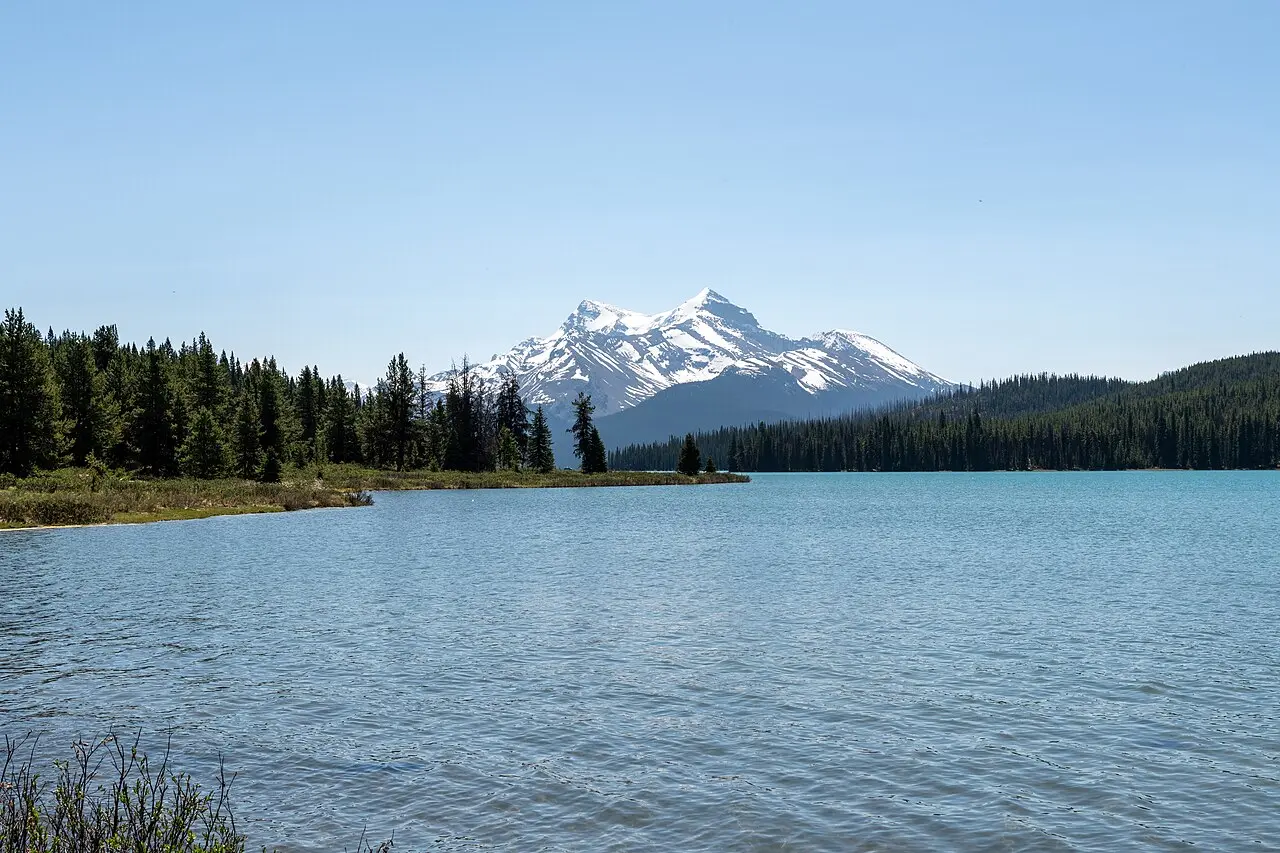
Yes. Maligne Lake, Maligne Lake Road, the boathouse picnic site and the Bald Hills trail are all listed “Open” on the same re-checked status page. The exception is Opal Hills: Parks Canada closed that hiking area on 25 September 2026 “until further notice” because a female grizzly with two cubs is in the area, and it still showed “Closed / Not permitted” on 19 October 2026, so check the status page before you plan that hike. The road and lake came back on 11 October 2024, and nothing on the recovery page suggests any of that is at risk again.
What does change with the season is the boat. Spirit Island - the postcard of a clump of spruce on a gravel spit, 14 km down the lake with no road or trail to it - is reachable only by cruise or by a multi-hour paddle. Pursuit, which runs the Maligne Lake Cruise, lists its 2026 season as 27 May to 11 October, weather dependent. Show up on the 12th and the boat isn’t running; you’re down to the free lakeshore trails at the near end, which don’t reach Spirit Island.
If you’re building a trip around the cruise, the season dates, prices and the Classic-versus-Premium tiers are in our Maligne Lake Cruise guide.
Everything else that’s open or closed (checked 22 September 2026)
Open
- Icefields Parkway (93N), back in service since 23 August 2024, so the drive between Lake Louise and Jasper works exactly as it always did; Highway 16, Athabasca Falls, Sunwapta Falls, Pyramid Beach, Patricia Lake, Lake Annette, Old Fort Point, Wabasso Lake and the Valley of the Five Lakes: open.
- Trails: virtually all of Jasper’s trails have reopened. The Valley of the Five Lakes trail came back for summer 2026 after a rebuild with a realigned section, better surfacing and new rest areas; Wabasso Lake and Curator reopened too, and Trail 9, the link from Old Fort Point to Valley of the Five Lakes, is open again with about a kilometre rerouted onto the ridge and its switchbacks rebuilt. On the Whistlers side trails 5 and 5d are open and so is part of 5c.
- Campgrounds closed on fixed 2026 dates: Snaring and Wilcox finished on 28 September; Whistlers, Icefield (tents) and the Icefield Centre RV lot finished on 12 October. Wapiti (loops AA to H only) runs to 28 October, and a winter loop takes over from 28 October to May 2027, with the closing date still to be announced (Parks Canada, as of 19 October 2026). Every backcountry campground is open, at 100% of pre-fire capacity.
- Visitor centres: the Jasper Information Centre in town, and the Parks Canada desk at the Icefield Centre, which closed after 27 September.
Closed or restricted
- Miette Hot Springs - closed for the season since 13 October 2026; Parks Canada expects guests back in spring 2027 (as of 19 October 2026).
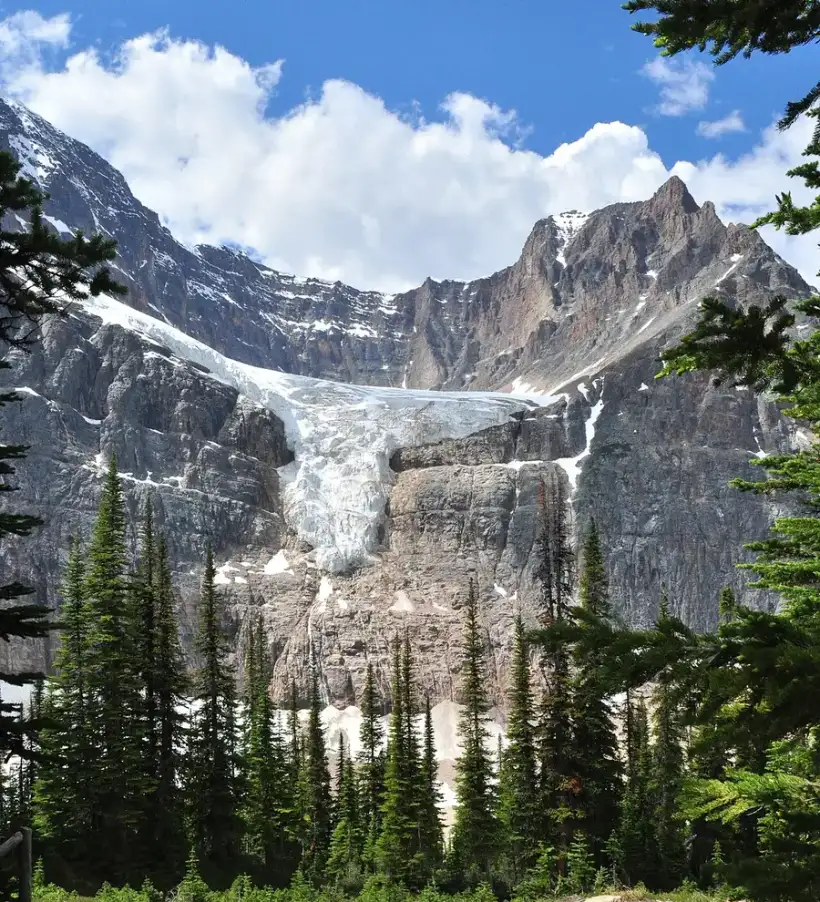
- Cavell Road, the Cavell day-use area, Path of the Glacier (trail 41) and Cavell Meadows (trail 42) - closed for the 2026 season, so there’s no Angel Glacier, no Cavell Pond and no meadows hike. Drainage and paving were scheduled for summer 2026, slope stabilization and retaining structures for fall 2026 through spring 2027, and the opening date will be set only once that work is done.
- Wabasso Campground and the Whirlpool Group Campground - closed for 2026; the separate Whirlpool backcountry campground is open. Overflow and Jonas finished their season on 7 September, Miette, Honeymoon Lake and Kerkeslin on 14 September - scheduled season ends, not new closures.
- Trail 9C in the Old Fort Point corridor, the stretch of Trail 7 behind the golf course between junctions 7a and 7e, and Trail 5b (Swamp Rider) on Whistlers - closed. In the burn corridor, anything more than 5 m from the trail centre line is off limits.
- Tonquin Valley via the Astoria River trailhead - listed as closed. The Portal Creek approach is open.
- The Palisades Centre and the land around the Maligne Horse Range - no access, though you’re fine on the Overlander Trail (trail 10) beside the horse range, and the general Palisades day-use area is open.
- Highway 93A at Mile 5 Hill - a slope failure and rockfall in spring 2026 put this stretch on the works list. Stabilization is due to start in fall 2026: from mid-September to mid-November Parks Canada expects 93A to be reachable from the south entrance only, with no through travel, and it expects the road to reopen for the 2026-27 Marmot Basin ski season, with single alternating lanes while work continues. Don’t count on 93A without checking 511 Alberta first.
Visitor numbers are back at pre-fire levels; frontcountry campsites aren’t, and still sit at 77% of what they were. The same crowd competes for nearly a quarter fewer frontcountry sites, so don’t wait - book campsites and rooms earlier than you would have in 2023, especially for July and August. Commercial accommodation in town is open but tighter than before, because rebuilding is still under way.
What the burn actually looks like
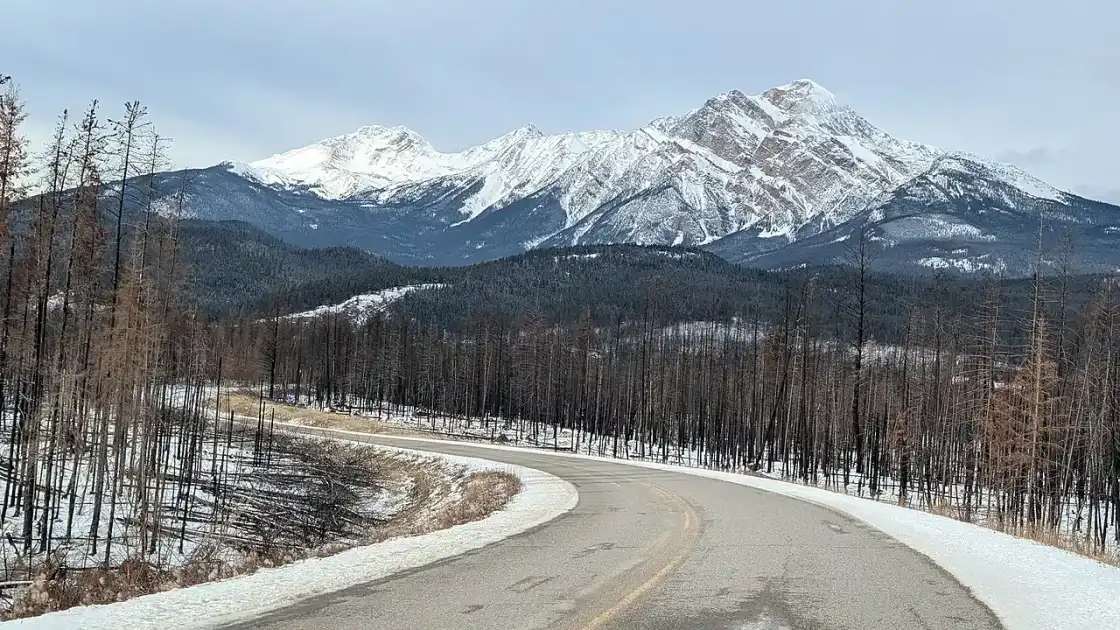
Trip listings rarely show this, so it’s worth setting expectations. Around the townsite and along parts of the highway corridor you drive through standing dead forest: black trunks, no canopy, snow or fireweed on the ground between them. It goes on for kilometres in places, and it’s genuinely striking rather than depressing - you can see the shape of the valley in a way you can’t when the trees are up.
Most of the park is untouched. Jasper covers 11,000 km2, the largest national park in the Canadian Rockies, and 32,000 hectares is 320 km2 of it. Drive twenty minutes down the Maligne road or south towards the Columbia Icefield and the forest is unburnt.
Pyramid Lake, Miette Hot Springs and the dark sky
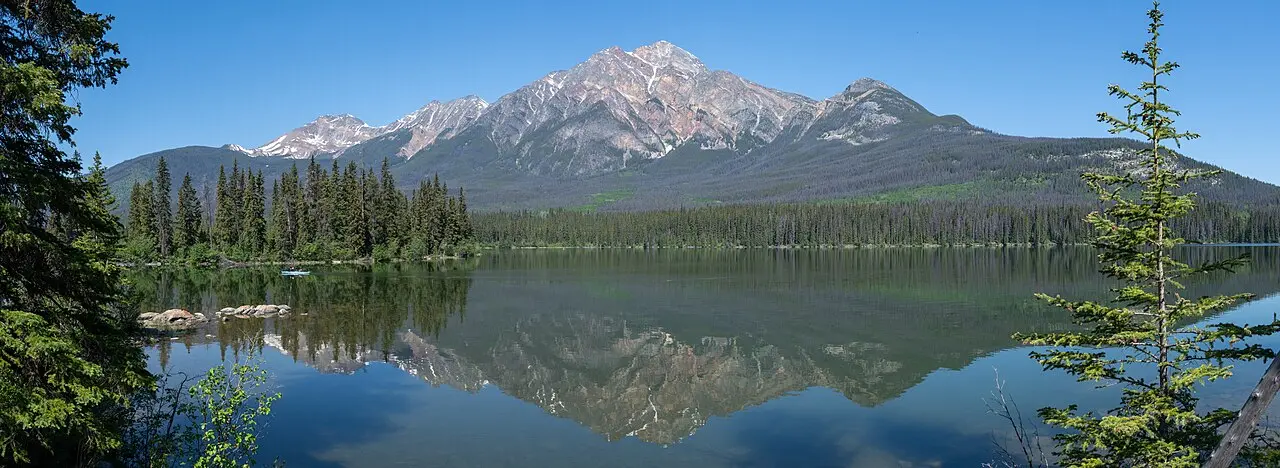
Pyramid and Patricia lakes sit ten minutes above the townsite: two small lakes with Pyramid Mountain reflected in them, an easy loop to walk or cycle, and the closest thing Jasper has to a sunrise routine.
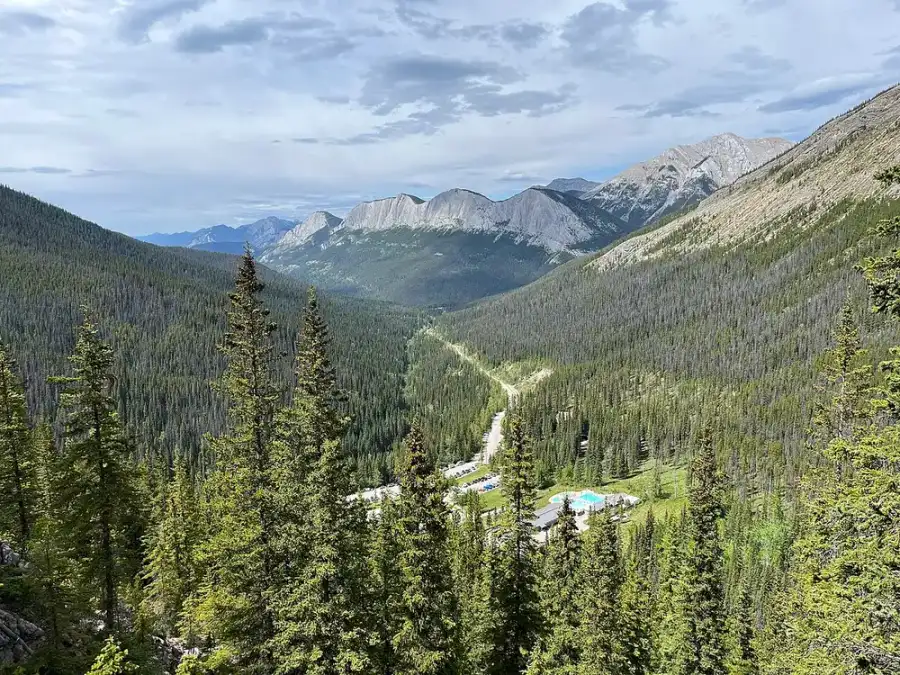
Miette Hot Springs lies about an hour east of town up a dead-end valley, and the drive is half the point: switchbacks, sheep on the road, and a soak at the end of it. The 2026 season ended on 12 October (pools open daily 11 am to 9 pm, last entry 8:30 pm); Parks Canada’s page says Miette Hot Springs is closed for the season and looks forward to welcoming guests back in spring 2027 (as of 19 October 2026).
The park has been a Dark-Sky Preserve since 2011, and with the townsite lights so far from most of the park, a clear night at a lakeshore pullout does the rest - that’s when the sky earns the label. Athabasca Falls and Sunwapta Falls, both open, are ten-minute stops off the Icefields Parkway rather than destinations in themselves.
Getting there and when to go
Jasper sits on Highway 16, the Yellowhead, roughly 365 km and four hours west of Edmonton. From Calgary or Banff the scenic approach is the Icefields Parkway, 232 km of mountains that deserves a full day rather than a transit. VIA Rail’s Canadian calls at Jasper station on the Toronto-Vancouver run, which makes a car-free trip possible if you stay in town.
July and August are warm, long and the busiest. September is quieter with better light and no bugs - you’ll notice the difference after Labour Day. Thanksgiving weekend is the edge of the season: in 2026 the Maligne Lake Cruise stopped after 11 October and Miette Hot Springs and the Whistlers, Icefield and Icefield Centre RV campgrounds after 12 October, the SkyTram (weather permitting) runs to 25 October 2026 and then closes for the winter, and Wapiti switches to winter camping on 28 October 2026. Pursuit’s 2027 calendar ends earlier, on 10 October for the cruise and 11 October for the SkyTram (as of 19 October 2026). From 1 November, or earlier if snow or ice covers the road, the Icefields Parkway needs snow tires or chains. Winter brings Marmot Basin, frozen lakes and the darkest skies of the year, but no Maligne Canyon icewalk: Parks Canada’s closure order prohibits winter access to the canyon, and Pursuit lists its guided icewalks as closed for the season (as of 19 October 2026). Spring is the awkward one: high trails are still under snow into late June.
Jasper or Banff
If you’ve got to choose: Banff has the famous lakes, the better public transport and the higher prices; it also had 4.56 million visits last year in 6,641 km2. Jasper has 11,000 km2, roughly half the visitors, wilder valleys and, for the 2026 season, two of its headline sights closed. Anyone who wants a quiet week of hiking and driving will get more out of Jasper. If you’ve only got two days and a list of photographs to take, start with Banff.
How to spend three days
With Maligne Canyon and Cavell out of the picture, a sensible three days looks like this. Day one: the Maligne valley - Medicine Lake, the lake itself, the boat cruise if you booked it and you’re here before its season ends (11 October in 2026; Pursuit lists 10 October for 2027), and a lakeshore walk at the north end, where the road stops. Day two: the townsite side - Pyramid and Patricia lakes at first light, Valley of the Five Lakes, Old Fort Point for the view over the Athabasca, and the SkyTram up Whistlers Mountain if the cloud is high (it runs, weather permitting, to 25 October 2026, then closes for the winter; Pursuit’s opening-dates page lists 21 May to 11 October for 2027, so check before you go). Day three: south on the Icefields Parkway to Athabasca Falls, Sunwapta Falls and the Columbia Icefield, roughly 105 km each way, which eats the whole day if you stop properly.
Add a fourth day and Miette Hot Springs (closed since 13 October, back in spring 2027) and a longer hike both fit. Anything shorter than two nights is really just a stop on a drive between Banff and Edmonton - don’t pretend otherwise.
Practical notes
- Individual daily admission is C$12.25 per adult; the separate C$24.50 family/group rate covers up to seven people arriving together in one vehicle. Admission is free for visitors 17 and under. Under the Canada Strong Pass, admission was free for everyone from 19 June to 7 September 2026, with parking and camping fees still charged; from 8 September 2026 the rates above apply again, and a park pass is required for anyone travelling inside the park beyond a few narrow exceptions (through-traffic on Highway 16, fuel stops, medical emergencies).
- The elk rut runs from late August to mid-October (Parks Canada posted its rutting-season warning on its bulletins page on 25 August), and the elk in the townsite aren’t tame. Keep 30 m from elk and deer, 100 m from bears and wolves.
- Fill the tank in Jasper before heading south, and expect to be off the grid: “cell service is available on each end of the Icefields Parkway but not on the Parkway itself”, Parks Canada says, and much of the rest of the park has no coverage either. Download offline maps before you leave town; a Canadian SIM or eSIM doesn’t help where there’s no tower.
- From 1 November to 31 March, and whenever else snow or ice covers the road, your vehicle must have snow tires or chains to drive the Icefields Parkway. Snow clearing runs 7 am to 3:30 pm, so a winter crossing belongs in the middle of the day.
- Book campsites and hotel rooms further ahead than the old guidebooks suggest - the same number of visitors is now sharing 77% of the campsites. For a fall trip, check the closing dates above: after 12 October only Wapiti stays open among the drive-in campgrounds. Our camping in Canada guide covers the reservation windows; for a room or a lodge instead of a tent, see where to stay in Jasper for the townsite-versus-valley-lodges-versus-Hinton decision.
- Check the Parks Canada “what is open” page before you drive to anything specific. It was last modified on 13 October 2026 when we checked it on 19 October 2026, and it’s the only list that gets corrected.
Read also
- Its neighbour to the south: Banff National Park
- The drive that links them, stop by stop: Icefields Parkway
- Picking a base: townsite, valley lodges or Hinton: where to stay in Jasper
- All the parks we cover: national parks hub
- The province around it: Canada by province
On the map
The map loads on click - to keep the page lightweight.
The map didn’t load. Check your connection and refresh the page.
Admission and opening hours
- Admission price
- Daily park pass C$12.25 adult, C$10.75 senior, C$24.50 family/group (up to 7 people in one vehicle); free for visitors 17 and under. Free for everyone 19 June - 7 September 2026 under the Canada Strong Pass; standard fees again from 8 September 2026.
- Opening hours
- Park open year-round. Maligne Lake, Maligne Lake Road and the Icefields Parkway are open; Miette Hot Springs is closed for the season after 12 October 2026 (Parks Canada expects guests back in spring 2027); Maligne Canyon and Cavell Road are closed for the whole of the 2026 season.
Fees from parks.canada.ca; closures from the Parks Canada "What is open" page (last modified 13 October 2026, read 19 October 2026), the park recovery page (31 August 2026) and the wildfire-area closure order issued 13 August 2026 (effective 14 August), still listed active. Status changes - check before you travel.
Details checked: September 22, 2026
Distance
- Vancouver ≈800 km · ~9-10 h via Kamloops and Highway 5, then Highway 16 east
- Calgary ≈410 km · ~5 h via Lake Louise and the Icefields Parkway, or ~7 h on the longer all-highway route through Edmonton The Icefields Parkway drive is the scenic route and needs a full day.
Read also

National parks · 11 min read
Point Pelee: Birding, Monarchs and Canada's Southern Tip
Verified · August 29, 2026Point Pelee in practice: the shuttle to the Tip, monarch season timing, Festival of Birds dates, 2026 fees, and why free admission ended before the peak.

National parks · 8 min read
Kluane: Icefields, Flightseeing and Mount Logan
Verified · August 28, 2026Kluane National Park 2026: Kathleen Lake trails, C$30 camping, Rocking Star flights from C$250, and Mount Logan at 5,959 m.

National parks · 7 min read
Riding Mountain National Park: Bison, Clear Lake & Highlands
Verified · August 27, 2026Riding Mountain in 2026: Lake Audy bison from your car, Clear Lake beaches, Wasagaming camping fees and the drive from Winnipeg.

National parks · 8 min read
La Mauricie National Park 2026: Parkway, Lakes & Camping
Verified · August 26, 2026La Mauricie NP: two hours from Montreal or Quebec City. 2026 gate C$10, 64 km Parkway, camping from C$33.75, Navette Nature shuttles.